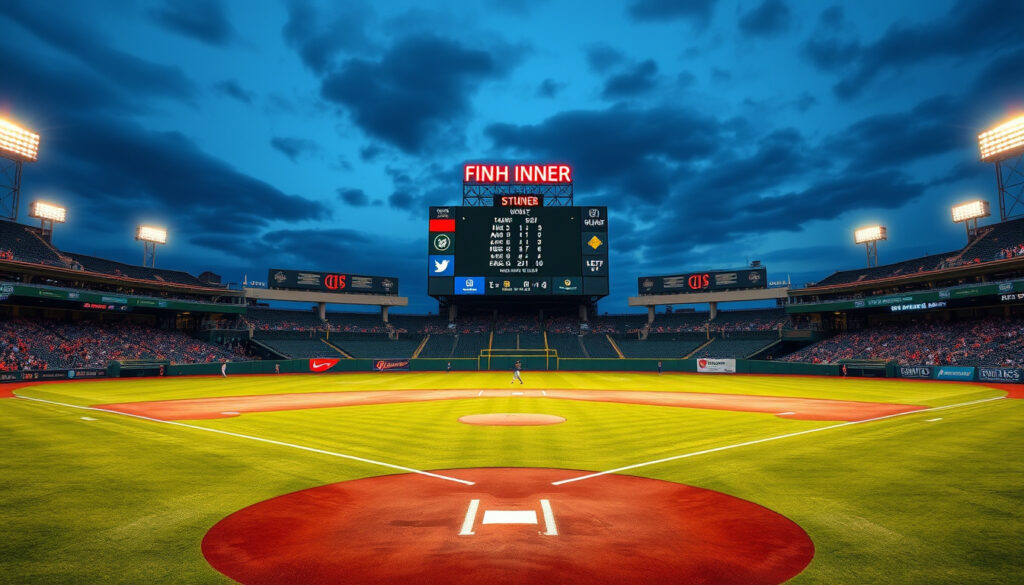
How Many Innings in Baseball? MLB Rules & Variations
Ask any fan who’s sat through a rain-shortened game what counts as a real game, and they’ll tell you: it depends on the league. A Little Leaguer’s evening ends after six innings; a college player’s marathon can stretch into extra frames with a runner already on second base. The standard professional game, though, has been locked at nine innings since the 19th century—and that consistency cuts across Major League Baseball, Minor League Baseball, and NCAA play alike.
MLB regulation game: 9 innings · Little League typical: 6 innings · High school standard: 7 innings · Extra innings trigger: tie after 9 · Official game minimum: 4.5 or 5 innings
Quick snapshot
- MLB, Minor League Baseball, and NCAA all play nine-inning regulation games (MLB.com official glossary)
- Little League games run six innings; high school baseball runs seven (Wikipedia rules overview)
- Minor league doubleheaders consist of two seven-inning games (Baseball Mode analysis)
- Exact mercy rule thresholds vary by individual college conference and minor league affiliate
- Junior and Senior League (13–16 and 14–16) divisions outside Little League use varying inning counts beyond the standard six
- Adoption status of 2026 minor league rule experiments pending confirmation after May 6, 2026
- Average nine-inning minor league game: 2:36 in 2024, rising to 2:38 in 2025 (FanGraphs analysis)
- Stolen base success rate in minors declined from 80.2% (2023) to 77.8% (2025) (FanGraphs data)
- Checked-swing appeals launch in Triple-A Pacific Coast League on May 6, 2026 (Baseball America report)
- International League will use ABS Challenge system aligned with MLB 2026 rules, with two challenges per team per game (FanGraphs rule details)
- Starting pitchers in minor league complex leagues can re-enter once per game if they threw 25+ pitches in the previous inning (FanGraphs pitcher rule)
Five distinct levels, five different rules: that’s what the data shows when you line up MLB against Little League against high school against college against Minor League Baseball.
| League / Level | Regulation Innings | Source |
|---|---|---|
| MLB (Major League Baseball) | 9 | MLB.com |
| Minor League Baseball | 9 | Baseball Mode |
| NCAA College Baseball | 9 | Refr Sports |
| High School Baseball | 7 | Wikipedia |
| Little League (ages 9–12) | 6 | Wikipedia |
| Minor League Doubleheader | 7 per game | Baseball Mode |
Are there 7 or 9 innings in baseball?
The answer depends entirely on which league you’re watching. Nine innings is the standard for every professional and college level in the United States—MLB, Minor League Baseball, and NCAA all follow the same nine-inning format for regulation games (MLB.com). Youth and amateur baseball, however, has long embraced shorter games to accommodate younger players, smaller fields, and limited attention spans.
MLB professional games
Major League Baseball mandates nine innings for every scheduled game. If the home team leads after the top half of the ninth, the bottom half is not played—this is the “walk-off” scenario familiar to any fan. The rule exists because once the home team has clinched victory, playing defense would serve no competitive purpose (Wikipedia). If a game is terminated early due to weather or field conditions, it becomes official once the home team has completed 4.5 innings with a lead, or five innings if the visiting team leads.
Youth and amateur leagues
Little League, the largest youth baseball organization in the world, caps its Major Division (ages 9–12) at six innings (Wikipedia). High school baseball, governed by the National Federation of State High School Associations (NFHS), plays seven innings. The rationale is practical: younger bodies fatigue faster, afternoon school schedules compress available time, and development takes priority over endurance.
Upsides
- MLB, NCAA, and Minor League all align on nine innings, providing consistent fan expectations
- Youth innings limits protect developing arms from overuse injuries
- Doubleheader structures (seven innings per game in minors) preserve scheduling flexibility
Downsides
- Travel baseball families must track multiple rule sets across different organizations
- No single universal standard exists for ages 13–18 outside high school varsity
- Confusion persists when casual fans assume all baseball games are nine innings
What happens if tied after 9 innings?
When a nine-inning MLB game ends in a tie after the ninth, play simply continues. There is no time limit and no predetermined cutoff—extra innings continue indefinitely until one team holds the lead when play stops (MLB.com). The longest MLB game in history ran 26 innings (Pawtucket vs. Rochester in 1981), though modern records cap around 20 innings for most marathon games.
Extra innings process
In MLB, extra innings follow the same structure as regulation innings—each team gets three outs per half-inning. There is no special runner placement in MLB extra innings, unlike college baseball. College baseball, however, employs a modified tiebreaker: from the tenth inning onward, each half-inning begins with a runner on second base (Refr Sports). This rule, adopted by the NCAA in 2018, was designed to speed up resolution and reduce player fatigue during long conference seasons.
“College baseball employs a modified tiebreaker in extra innings with a runner on second base to expedite the conclusion of tied games and prevent prolonged contests.” — Refr Sports
“The Knickerbocker Rules of 1845 established the framework, but it took decades for the nine-inning norm to crystallize. By the time the National League formed in 1876, nine innings had become the accepted standard.” — Wikipedia baseball history
Win conditions
The winning team must simply be ahead when the game ends, which can occur in three ways: the team batting in the bottom of an extra inning scores enough runs to take the lead; the visiting team scores in the top of an extra inning and the home team fails to answer in the bottom half; or the opposing team concedes by running out of eligible pitchers (rare, but possible in very long games).
Minor league baseball has begun experimenting with its own extra innings variation. The United Shore Professional Baseball League (USPBL) places a runner on first base for the team that lost the pre-game coin toss if the score remains tied after nine innings (USPBL). This experimental approach has not yet been adopted by MLB or NCAA.
Why is baseball only 9 innings?
The nine-inning standard traces back to the mid-19th century, when baseball was codified as a professional sport. Early games varied in length—sometimes five innings, sometimes seven—but the nine-inning format gradually became standard by the 1880s as the sport’s national popularity grew (Wikipedia).
Historical origins
Before standardization, baseball borrowed heavily from rounders and cricket, neither of which had fixed inning counts. The Knickerbocker Rules of 1845 established the framework, but it took decades for the nine-inning norm to crystallize. By the time the National League formed in 1876, nine innings had become the accepted standard, likely because it provided enough action for a full afternoon without exhausting players on primitive fields without modern transportation networks to shuttle players between games.
Regulation standards
Official MLB rules specify that a regulation game consists of nine innings unless terminated early due to weather, field conditions, or the mercy rule (rarely invoked in MLB, but defined in the official rulebook) (MLB.com). The home team bats second in each inning, which means if they lead after the top of the ninth, the game ends immediately.
The nine-inning structure creates a consistent broadcast window for television and an expectation for fans—roughly 3 hours, though game times have fluctuated with pitch clock rules. This predictability shapes everything from advertising revenue to tailgate schedules to children’s bedtimes.
How many innings can you go in a baseball game?
There is no upper limit. A baseball game can theoretically continue indefinitely, adding innings until a winner emerges. In practice, games rarely exceed 15 innings in the modern era, and games beyond 20 innings are historically notable.
Maximum limits
Neither MLB nor any other U.S. baseball league imposes a hard ceiling on innings. The practical constraints are pitcher availability (minimum rest requirements in professional baseball), player safety (especially in youth leagues), and scheduling (doubleheaders and weather delays). Most modern MLB games that go beyond 15 innings involve exhausted bullpens and position players pitching.
Recorded longest games
The MLB record for longest game by innings is 26, achieved between the Pawtucket Red Sox and Rochester Red Wings on April 18–19, 1981—lasting 8 hours and 25 minutes over two days. The game was eventually suspended and completed later in the season. Modern scheduling pressures and pitch clock rules make such marathons less likely, though extra innings games remain a regular feature of the regular season.
How many innings in baseball minor league?
Minor League Baseball follows the same nine-inning format as MLB for standard games, but doubleheaders introduce a key variation: each game runs seven innings (Baseball Mode). This modification allows teams to play two games in a single afternoon or evening while keeping each game short enough to protect player health and accommodate travel schedules.
MiLB levels
Single-A, Double-A, and Triple-A levels all use nine innings for full-length games (Baseball Mode). The pitch clock has shaved game times meaningfully compared to pre-clock eras, though average minor league game duration rose from 2:36 in 2024 to 2:38 in 2025 (Baseball America). Pitch clock violations remain rare—roughly one per every 5.2 games (Baseball America).
Spring training
Spring training games typically follow the same nine-inning format as regular season games, though managers frequently pull starters after two to four innings to preserve arm health for Opening Day. Exhibition games can be shortened by mutual agreement, especially late in spring training when roster decisions are finalized.
Minor league baseball is testing several experimental rules for 2026: checked-swing appeals (starting May 6 in Triple-A Pacific Coast League) (Baseball America), a 45-degree threshold for checked swings in the International League (Baseball America), and a re-entry rule allowing starting pitchers to return once if they threw 25+ pitches in the previous inning (FanGraphs). These experiments signal where MLB rules may head next.
How many innings in baseball World Series?
The World Series follows standard MLB rules: nine innings per game, with the potential for extra innings if the game is tied after nine (MLB.com). The longest World Series game was Game 3 of the 2008 Tampa Bay Rays vs. Philadelphia Phillies, which went 18 innings and lasted 5 hours and 55 minutes. Unlike regular season games, World Series games are rarely shortened for time or weather—they play until there’s a winner.
Postseason vs. regular season
Postseason games follow identical inning rules to regular season games—no special mercy provisions, no abbreviated format. However, teams manage their bullpens more aggressively in short series where there is no tomorrow, and starting pitchers typically throw more innings in postseason play than in regular season because every game carries elimination stakes.
How many innings in baseball Japan (NPB)?
Nippon Professional Baseball (NPB), Japan’s top league, mirrors the nine-inning standard used in MLB (Wikipedia). However, NPB implements a tie after 12 innings in regular season games—a rule adopted to accommodate dense scheduling and prevent exhausting extra-inning marathons. If the score remains tied after 12 innings, the game ends as a draw, and both teams earn a half-win in the standings.
International variations
The World Baseball Classic (WBC) and other international tournaments typically follow standard MLB rules, playing nine innings with the possibility of extra innings. Olympic baseball, however, has historically used shorter formats due to compressed tournament schedules, sometimes limiting games to seven innings in round-robin stages.
How many innings in baseball WBC?
The World Baseball Classic follows MLB rules: nine innings for all games, including championship finals. Extra innings are played if the score is tied after nine (Wikipedia). The WBC is unique among international tournaments in maintaining the full nine-inning format across all rounds, preserving the game’s traditional structure at the highest levels of international competition.
Related reading: extra innings rules in other leagues · game structure variations
norwelllittleleague.com, suzitee.com, community.hsbaseballweb.com
While MLB mandates nine innings, middle school game lengthsmiddle school game lengths often shorten to about two hours with seven-inning formats for young players.
Frequently asked questions
Is baseball 12 innings?
In MLB, no—a regulation game is nine innings, and extra innings continue indefinitely if tied. However, Japan’s NPB caps regular season games at 12 innings with a draw declared if still tied. The World Baseball Classic and Olympics follow the nine-inning MLB standard with unlimited extra innings.
Why is a game 9 innings?
The nine-inning standard dates to the late 19th century when baseball codified as a professional sport. By the 1880s, nine innings had become the accepted norm, providing enough action for a full afternoon without the exhaustion of longer formats on primitive fields and transportation systems (Wikipedia).
What is the Ohtani rule?
The “Ohtani rule” refers to MLB’s designated hitter (DH) rule, named partly for Shohei Ohtani’s two-way excellence. In MLB, teams may use a DH to bat for any pitcher, allowing pitchers to focus on pitching without batting. In the National League (where Ohtani played for the Dodgers), pitchers traditionally bat, but Ohtani’s ability to both pitch and hit led to special roster and injury management considerations.
How many innings in baseball World Series?
World Series games follow standard MLB rules: nine innings with unlimited extra innings if tied. No mercy provisions or shortened formats apply in postseason play.
How many innings in baseball Japan?
Nippon Professional Baseball (NPB) uses nine innings for standard games, but regular season games end in a draw if still tied after 12 innings (Wikipedia). This differs from MLB’s unlimited extra innings approach.
How many innings in baseball WBC?
The World Baseball Classic follows standard MLB rules: nine innings with unlimited extra innings if tied, matching the format used in MLB regular season and postseason.
How many innings in baseball spring training?
Spring training games typically follow the nine-inning format, but managers routinely pull starters early (often after two to four innings) to preserve arm health. Exhibition games can be shortened by mutual agreement between teams, especially in late March as rosters narrow.
Meer gerelateerde berichten
 Horoscope du Jour Taureau: Today’s Taurus Horoscope
 What Is the Maximum CPP Benefit for 2025? Official Amounts
 Pro Hockey Life Barrie | Location, Hours, Services & Products
 Montreal Grand Prix 2025: George Russell Wins Race
 What Is a Soft Fork? Definition, Hard Fork Comparison
 A&W Specials Today: Deals, Discounts, and Menu Prices
 Wonder of the Seas: Size, Features and Cruise Guide
 CPP and OAS Retirement Age Changes in Canada: 2026 Updates