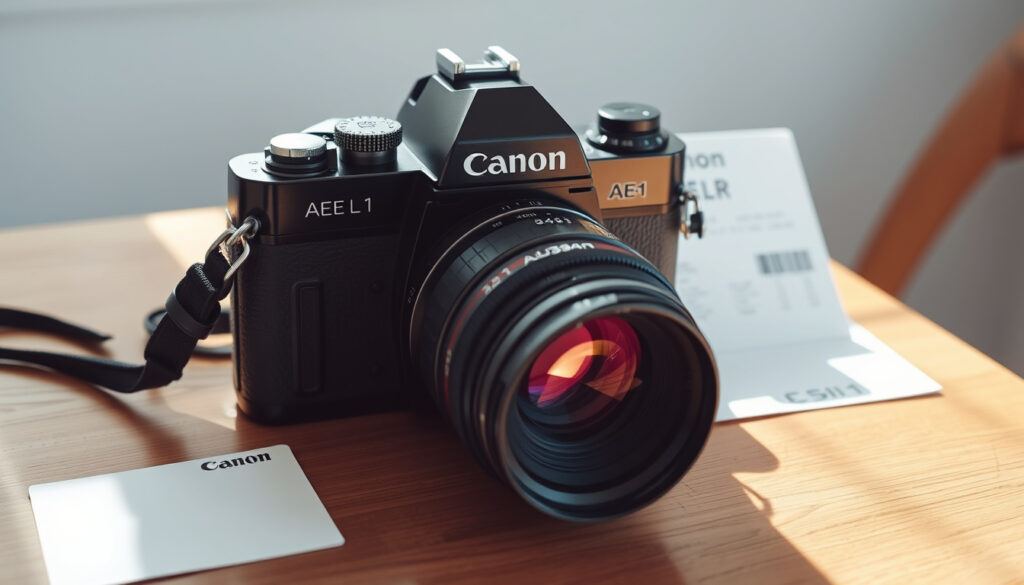
Canon AE-1: Worth It? Price, Specs and Buyer Guide
If you’ve been hunting for a vintage film camera, the Canon AE-1 has probably crossed your desk — or at least your search results. Released in 1976, this 35mm SLR became a go-to for beginners and professionals alike. The AE-1 Program variant followed in 1981 with even more automatic modes. But here’s what brings most people here: used market prices have climbed steadily over the past decade, and not every deal is what it seems. This guide cuts through the noise with current pricing data and a practical risk assessment before you hand over any cash.
Typical Price Range: $175-225 ·
Camera Type: 35mm SLR ·
Weight: 575g (Program model) ·
Production Status: Discontinued
Quick snapshot
- Exact value by specific condition grade
- Current 2026 eBay average pricing trends
- Servicing costs from independent repair shops
- AE-1 launched 1976; Program added 1981 (Vintage Camera Digest)
- Original 1981 price: $225.50 (≈$783 today) (Vintage Camera Digest)
- Film photography demand continues supporting prices
- FD lens market remains active on used platforms
| Specification | Value |
|---|---|
| Type | 35mm single-lens reflex (SLR) |
| Lenses | Interchangeable Canon FD |
| Manufacturer | Canon |
| Status | Vintage, discontinued |
| ISO Range | 12-3200 |
| Flash Sync | 1/60 second |
| Viewfinder Coverage | 94% |
| Battery | 4LR44 6V |
Is the Canon AE-1 Worth It?
The question isn’t whether the AE-1 is a capable camera — it absolutely is. The real question is whether the price you’re paying matches the condition and reliability you’re getting. Ken Rockwell calls the AE-1 Program “one of the most popular cameras of all time” and “a spectacular camera,” but even he acknowledges that buying used means inheriting someone else’s maintenance history.
Pros and cons
Upsides
- Program AE mode handles exposure automatically for beginners
- Lightweight at 575g — easy to carry on day trips
- FD lens ecosystem remains active on used markets
- Horizontal-travel cloth shutter produces distinctive film character
Risks of used purchases
Buying a 40+ year-old camera sight unseen carries specific risks. The horizontal-travel cloth focal-plane shutter — while mechanically elegant — degrades over time if the camera sat unused for years. Shutter lubrication can congeal, causing sticky speeds or inconsistent timing. The electromagnet controls also depend on the battery maintaining proper voltage, which drops as alkaline batteries age even if they’re “new.”
What’s unclear from most listings: whether the previous owner stored the camera in humidity-controlled conditions. Mold on the mirror or focusing screen, stuck aperture blades, and corroded battery contacts are all common finds in “bargain” AE-1 units. The CollectiBlend data showing AE-1 prices ranging from $80 to $127 in recent sales reflects this condition spread — not just market variation.
How Much Does a Canon AE-1 Typically Cost?
Price data for the AE-1 and AE-1 Program spans a wide range, and understanding why matters more than the headline numbers. CollectiBlend records show average-condition AE-1 units trading around $80-90, while better-preserved examples command premiums. Swappa’s active listings average $221 for the AE-1, reflecting seller pricing optimism rather than closed sale data.
Price ranges by condition
Three market tiers emerge from the data. Budget-tier cameras (below $125) often show operational quirks: sticky shutter speeds, dim metering, or cosmetic wear. Mid-range units ($125-$200) typically pass functional tests but lack recent servicing. Premium listings ($200+) usually include seller verification, better cosmetics, or bundled accessories like a tested 50mm f/1.8 lens.
Cameras priced significantly below $175 without lens should trigger inspection questions. A shutter timing test and metering verification are minimum checks before transfer.
AE-1 vs Program pricing
The AE-1 Program commands a premium over the base AE-1, typically $30-50 more in equivalent condition. That differential buys the Program AE mode, brighter focusing screen, and compatibility with the faster Power Winder A2. For buyers who plan to shoot in auto mode, the Program version justifies the cost difference.
Is the Canon AE-1 Vintage?
By any meaningful definition, yes. Released in 1976, the AE-1 qualifies as a classic film camera with nearly five decades of production history. The combination of manual focus, mechanical shutter, and analog exposure system places it firmly in the vintage category that collectors and film photography enthusiasts actively seek.
Production history
Canon launched the AE-1 in 1976 as an entry-level automated SLR. The company refined the design through the late 1970s, and the AE-1 Program arrived in 1981 with the Program AE mode that automatically sets both shutter speed and aperture — a first for Canon’s FD-mount lineup. Production continued until the late 1980s as newer autofocus systems emerged, making the AE-1 Program one of Canon’s final manual-focus SLRs before the EF mount era.
Value as collectible
The AE-1 and AE-1 Program occupy a specific niche in the collectible market. They’re not rare — Canon produced millions — but they’re historically significant as cameras that democratized auto-exposure for amateur photographers. The “vintage premium” manifests more in price stability than dramatic appreciation: expect to pay 2020s pricing levels rather than early-2010s bargain rates.
Is the Canon AE-1 Still Made?
No. Canon discontinued the AE-1 Program decades ago, and no new FD-mount cameras have entered production since the early 1990s. The FD mount itself was replaced by Canon’s EF autofocus system in 1987, making any FD-mount camera a product of closed manufacturing ecosystems.
Discontinuation details
Canon gradually phased out FD-mount cameras as autofocus became the standard. The AE-1 and AE-1 Program lingered in production longer than many Canon’s other manual focus models due to sustained demand, but by the mid-1990s, new FD-mount cameras had effectively disappeared from retail channels. Today, all available units are pre-owned.
Availability today
The used market remains active. eBay, Swappa, KEH, and specialty retailers like Brooklyn Film Camera all list AE-1 units regularly. Refurbished or serviced examples command premiums, while “as-is” listings attract buyers willing to accept repair risks. The key variable isn’t availability — it’s quality consistency across sellers.
Battery type confusion trips up many buyers. Both AE-1 models require a 4LR44 6V battery — not the more common CR2 or 2CR5. Stock up before your first shooting session.
Why is the Canon AE-1 So Popular?
The AE-1’s popularity stems from a convergence of factors that remain relevant decades after production stopped. It’s one of those rare cameras that succeeded as both a mass-market product and a genuinely capable photographic tool.
Beginner features
The Program AE mode on the AE-1 Program handles exposure automatically — point, compose, and fire. This simplicity appeals to photographers transitioning from digital or point-and-shoot film cameras. Brooklyn Film Camera describes the AE-1 Program as “fantastic for photographers of any skill level from beginners to seasoned professionals,” noting its full manual or automatic modes. The learning curve is shallow for beginners while offering room to grow.
Market demand
Film photography’s revival in the 2010s created fresh demand for manual-focus cameras. The AE-1 benefits from this trend because it occupies a price-performance sweet spot — more capable than entry-level cameras but more affordable than professional models like the Canon F-1. The FD lens ecosystem adds value: many photographers already own compatible lenses from other Canon FD-mount bodies.
| Feature | Canon AE-1 | Canon AE-1 Program |
|---|---|---|
| Release Year | 1976 | 1981 |
| Exposure Modes | Shutter priority, Manual | Program AE, Shutter priority, Manual |
| Shutter Speeds | 2s to 1/1000s | 2s to 1/1000s |
| ISO Range | 12-3200 | 12-3200 |
| Focusing Screen | Standard | Brighter, interchangeable (8 options) |
| Viewfinder Coverage | Not specified | 94% at 0.83x magnification |
| Weight | Not specified | 575g |
| Dimensions | Not specified | 87×141×47.5 mm |
| Flash Sync | Not specified | 1/60s |
| Metering | TTL center-weighted | TTL center-weighted, EV 1-18 at ISO 100 |
| Power Winder | Compatible | Supports Power Winder A2 (faster) |
| Self-Timer | Built-in | Built-in with beeper |
The comparison reveals why the Program model commands a premium: the auto-exposure simplicity, brighter viewfinder, and faster winder support make it the more practical choice for most buyers despite identical shutter specs.
The electromagnet-controlled cloth shutter delivers character but limits maximum speed to 1/1000s — slower than some contemporaries. For action photography, this constraint matters; for landscapes and portraits, it’s irrelevant.
“The Canon AE-1 Program is one of the most popular cameras of all time, and for very good reason: it is a spectacular camera.”
— Ken Rockwell (Ken Rockwell photography reviews)
“The Canon AE-1P is a fantastic camera for photographers of any skill level from beginners to seasoned professionals.”
— Brooklyn Film Camera (Brooklyn Film Camera retailer)
Related reading: What Is a Phishing Scam – Definition, Examples & Prevention Guide · Words With Friends Cheat – Best Solvers and Legality Guide
Frequently asked questions
What battery does the Canon AE-1 use?
Both the Canon AE-1 and AE-1 Program use a single 4LR44 6V battery. This alkaline battery powers the shutter timing electronics, metering system, and auto-exposure controls. Without a functioning battery, the camera defaults to a fixed shutter speed (typically 1/60s) and requires manual exposure estimation.
What film is used in the Canon AE-1?
The AE-1 accepts standard 35mm film in both color (negative and slide) and black-and-white formats. ISO settings from 12 to 3200 provide flexibility for low-light films like Kodak Tri-X or high-speed options like Fuji Natura 1600. The lack of DX coding means you set ISO manually on the camera body.
Is 1.8 or 2.2 aperture better?
The standard 50mm f/1.8 FD lens offers a wider maximum aperture (f/1.8) than the 50mm f/1.2 — that’s a significant difference in low-light performance and background blur depth-of-field. For most users, the f/1.8 provides the best balance of cost, availability, and performance. The f/1.2 version is heavier, more expensive, and harder to find.
What are Canon AE-1 specs?
Key specs for the AE-1 Program: shutter speeds from 2s to 1/1000s, ISO range 12-3200, TTL center-weighted metering (EV 1-18 at ISO 100), 94% viewfinder coverage at 0.83x magnification, flash sync at 1/60s, and 575g weight. The Canon Camera Museum lists all official specifications for both models.
Where to find Canon AE-1 for sale?
Specialty film camera retailers like Brooklyn Film Camera offer serviced units with warranties. Mainstream marketplaces (eBay, Swappa) provide broader selection but variable condition guarantees. KEH Camera and MPB specialize in used photo equipment with grading systems that reduce buying uncertainty.
Canon AE-1 eBay prices?
Active eBay listings for AE-1 bodies range from $75 (functional quirks) to $200+ (tested and serviced). The AE-1 Program commands $30-50 premiums over base AE-1 listings in comparable condition. Closed sales data from sites like Swappa shows typical final prices 10-20% below asking, so factor negotiation room into your budget.
Are old cameras like AE-1 worth money?
Yes — in the sense that a well-maintained AE-1 Program retains value and will likely sell for 80-90% of purchase price if kept functional. The original 1981 price of $225.50 translates to approximately $783 in 2025 dollars, meaning current used prices still represent significant depreciation. Unlike digital cameras, film cameras don’t suffer from sensor degradation, extending their useful lifespan indefinitely with proper maintenance.
The AE-1 and AE-1 Program occupy a proven position in film photography: capable enough for serious work, accessible enough for newcomers, and available enough through used channels that entry doesn’t require significant capital. The market has stabilized around $175-225 for body-only purchases in good working condition, with premiums for serviced units and bundled lenses.
The trade-off is inherent in any vintage mechanical device: you’re buying decades of accumulated wear with unknown maintenance history. The cameras that command top dollar have documented service records or come from sellers who specialize in film camera restoration. Budget deals exist, but they carry hidden costs — either in repair bills after purchase or in compromised images when the shutter timing drifts.
For a buyer weighing the AE-1 against alternatives, the calculus is straightforward: the Program model’s auto-exposure alone justifies the modest premium over the base AE-1, and the FD lens ecosystem ensures you’ll never lack glass. Factor $50-100 for a CLA (clean, lubricate, adjust) service within the first year, and the total cost of ownership remains reasonable for a camera that can produce professional results in skilled hands.
Meer gerelateerde berichten
 Elon Musk and Amber Heard: Relationship, Breakup & Diagnosis
 RBC Online Sign In – Step-by-Step Login and Troubleshooting Guide
 Fawcett Funeral Home Collingwood – Contact, Services, Obituaries
 Jesse Plemons Weight Loss: 50 Pounds Naturally, No Ozempic
 James Van Der Beek GoFundMe: Why $2M+ Was Raised for His Family
 How to Silence Notifications on Android [2024 Guide]
 How Many Innings in Baseball? MLB Rules & Variations
 House for Sale Kingston: Compare Galway vs Dublin