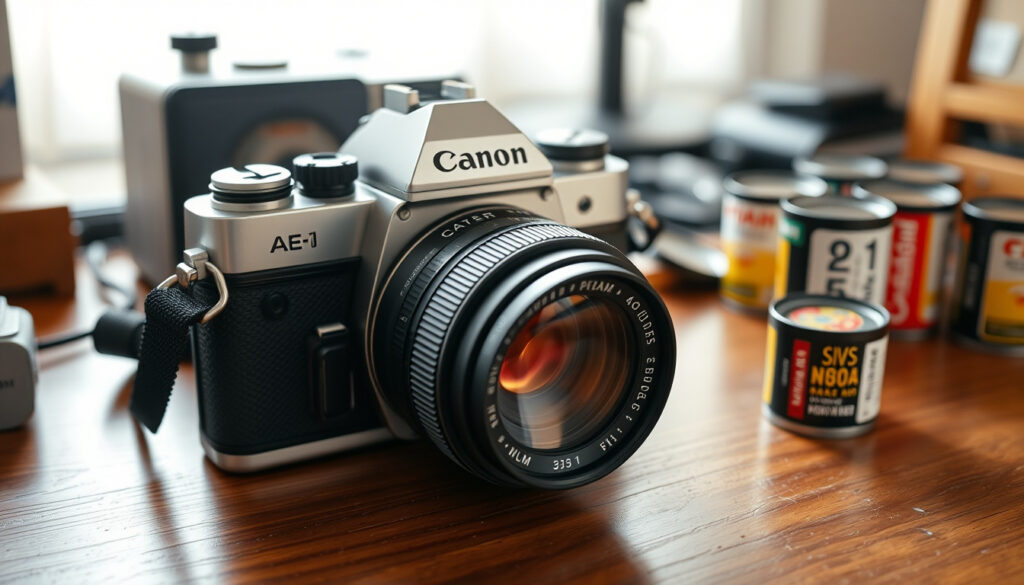
Canon AE-1 Review: Worth It? Price, Specs & Buying Guide
There’s a particular satisfaction in hearing that mechanical click of a film shutter — something smartphone cameras will never replicate. The Canon AE-1 has become the go-to entry point for this analog revival, offering solid mechanics at an approachable price. Since April 1976, Canon reportedly sold 5.7 million units, and secondary market prices reflect that enduring demand. For anyone curious about shooting film in 2024, the AE-1 remains one of the most accessible vintage SLRs to track down and shoot.
Typical Price Range: $175-225 without lens · Camera Type: 35mm SLR film · Weight: 565g (Program model) · Dimensions: 14×9×5cm · Production Status: Discontinued
Quick snapshot
- Exact current market values in 2024-2026 (Max Kent)
- Long-term reliability without recent service (YouTube camera inspection guides)
- Regional price variations between US, EU, Asia (Max Kent)
- Released April 1976, produced through 1984 (Wikipedia)
- AE-1 Program succeeded it in April 1981 (Wikipedia)
- Program produced 1981-1989 (Wikipedia)
- Prices likely stay elevated through 2024 film revival (Casual Photophile)
- Serviced units command premiums of $50-100+ (Max Kent)
- Alternatives like Pentax K1000 gaining attention (YouTube camera reviewers)
Five key specs appear across every buyer comparison: body type, lens mount, weight, shutter range, and current production status.
| Specification | Value |
|---|---|
| Type | 35mm single-lens reflex film camera |
| Mount | Canon FD |
| Weight | 565g (Program model) |
| Status | Vintage, discontinued |
| Avg Price | $175-225 |
Is the Canon AE-1 Worth It?
The Canon AE-1 earned its reputation as the camera that brought automatic exposure to the masses. Its Program mode lets beginners point and shoot without understanding shutter speeds or aperture rings, making film photography less intimidating. According to Casual Photophile (photography review publication), the AE-1 Program remains “the best beginner-level 35mm SLR” because it teaches core concepts while handling exposure automatically.
Pros and cons for beginners
Beginners benefit most from the Program mode’s simplicity, but the AE-1 rewards learning as well. The shutter priority system lets more experienced shooters control motion blur while the camera handles aperture.
- Upside: Program mode automates exposure for first-time film shooters
- Upside: Split-image prism focusing aids manual focus accuracy
- Upside: Overexposure warning prevents ruined frames
- Downside: Requires battery for all functions — no mechanical fallback
- Downside: 4LR44 battery drains faster than modern designs
Risks of buying used
Buying below $175 carries genuine risk. Max Kent (photographer and camera reviewer) warns that units priced too low often hide problems like shutter squeal, sticky mechanisms, or broken battery doors. A thorough CLA (cleaning, lubrication, adjustment) service costs $75-150, which eats into any “bargain” quickly.
“If you find either one of these in good working condition with no shutter squeal, a non-broken battery door, and a price of around 100 to $150, it’s probably worth it.”
Cameras priced under $150 likely need $100+ in repairs. Serviced units at $200+ often represent better value than cheap “working” examples that fail mid-roll.
The implication: a working AE-1 under $150 may cost more overall than a serviced unit at $200. Buyers should factor in potential service bills before chasing low prices.
How Much Does a Canon AE-1 Typically Cost?
Body-only prices for the Canon AE-1 typically range from $175-225 in 2024, with UK prices settling around £150-180. This represents a significant jump from the 2018-2019 baseline of $122-132 for equivalent condition units, according to CollectiBlend (vintage camera price tracker).
Price ranges for AE-1 vs Program
The AE-1 Program commands slightly higher prices than the base AE-1, typically $200-275 for body-only units in good condition. The Program adds program automatic exposure mode and an electronic meter readout over the standard AE-1, making it more appealing to beginners willing to pay a premium.
“The Canon AE-1 Program is the best beginner-level 35mm SLR.”
— Casual Photophile, photography review publication
| Model | Typical Range | Notes |
|---|---|---|
| Canon AE-1 body | $175-225 | Shutter priority only |
| Canon AE-1 Program body | $200-275 | Adds program AE mode |
| With decent 50mm f/1.8 lens | Add $50-75 | FDn versions preferred |
| Serviced/CLA’d unit | $225-300+ | Worth the premium |
Factors affecting value
Three factors drive pricing: cosmetic condition, mechanical function, and recent service history. Cameras with clean viewfinders, responsive shutters, and documentation of CLA service command the highest prices. YouTube camera reviewers (camera expert reviewers) note that units with no shutter squeal, intact battery doors, and clear finder optics warrant $100-150 valuations — anything below that threshold invites repair costs.
The 1981 launch price of $225.50 for an AE-1 Program body equals approximately $783 in 2025 dollars, per Vintage Camera Digest (vintage camera price analysis). Today’s $200-275 asking prices reflect a relative discount against inflation-adjusted originals.
What this means: despite elevated prices versus 2019, the AE-1 Program still costs less in real dollars than its original 1981 launch price. Buyers paying $250 today get more camera per dollar than 1981 buyers paid at launch.
Is the Canon AE-1 Vintage?
The Canon AE-1 qualifies definitively as vintage by any measure. Production ended in 1984, making it a 40-year-old design that hasn’t been manufactured in decades. Wikipedia (encyclopedic camera database) confirms both the April 1976 release date and the 1984 discontinuation, establishing its full production span of approximately eight years.
Production history
The AE-1 launched as a revolutionary product: the first microprocessor-equipped SLR with shutter priority automatic exposure. High5 Cameras (camera review publication) notes that Canon “pretty much undercut everyone on the market” with an affordable automatic SLR price at launch, disrupting competitors like Nikon and Pentax.
“The AE-1 pretty much undercut everyone on the market. The price was very appealing.”
— High5 Cameras, camera review publication
- 1976: Canon AE-1 released — first microprocessor SLR
- 1981: Canon AE-1 Program added program mode, released April 1981
- 1984: Canon AE-1 production ended
- 1989: Canon AE-1 Program production ended
Current availability
Used units circulate through eBay, KEH Camera, MPB, and local classifieds. The film photography revival sustained demand through 2024, keeping prices elevated despite the camera’s age. Finding a clean, serviced example requires patience and willingness to pay premiums for documented maintenance history.
Sticky shutter syndrome affects older AE-1 units, particularly those stored in humid conditions. This common failure renders the camera inoperable without professional repair ($75-150 service cost).
The pattern: vintage status drives collector appeal and price appreciation, but 40-year-old mechanics demand either recent service or acceptance of repair risk.
Why Is the Canon AE-1 So Popular?
The AE-1’s popularity stems from a rare combination: accessible automatic exposure, reliable Canon FD lens ecosystem, and relatively simple mechanics that skilled repair technicians can service. Cameras by Max (camera review blog) describes it as “suitable for beginners and experienced with easy film photos,” appealing across skill levels.
Beginner features
Three features make the AE-1 beginner-friendly beyond Program mode. The built-in light meter handles exposure calculations automatically. The split-image prism focusing screen helps beginners achieve tack-sharp focus. The overexposure warning alerts shooters before they waste expensive film on blown highlights.
| Feature | Beginner Benefit |
|---|---|
| Program AE mode | Fully automatic exposure control |
| Split-image prism | Visual focus confirmation |
| Overexposure warning | Prevents blown highlights |
| Flash hotshoe | Easy flash integration |
| Self-timer | Group and self-portraits |
Film revival appeal
The analog photography revival created fresh demand for cameras like the AE-1. Film stocks like Kodak Portra 400 and Cinestill 800T gained social media cachet, drawing younger photographers to film who never shot it before. The AE-1’s affordable entry point and learning-friendly design made it the default recommendation for this new audience.
The pattern: each generation rediscovers the AE-1. 1980s beginners learned on it, 2000s students shot film with it, and 2020s content creators embrace it for the aesthetic and ritual. This appeal sustains demand regardless of technological obsolescence.
Canon AE-1 Specs and Features
The AE-1’s specifications reflect its 1976 design era: analog controls, mechanical shutter, and electromagnetic metering. Understanding these specs helps buyers set realistic expectations about handling, maintenance, and lens selection.
Key technical specs
| Spec | Canon AE-1 | AE-1 Program |
|---|---|---|
| Shutter speeds | 2s to 1/1000s + B | 2s to 1/1000s + B |
| Flash sync | 1/60s | 1/60s |
| ISO range | 25-3200 | 25-3200 |
| Weight | 590g body | 575g body |
| Dimensions | — | 141×88×47.5mm |
| Battery | 4LR44 6V | 4SR44/PX28A compatible |
Lens compatibility
The Canon FD mount accepts decades of Canon glass. The FDn variant (chromed mount, bayonet) represents the most common and readily available option. Pre-AI lenses work but require converted aperture rings. Shoot It With Film (analog photography publication) recommends the 50mm f/1.8 as the best starter lens — sharp, affordable ($75-100 used), and widely available.
- 50mm f/1.8: The standard starter lens — affordable, sharp, abundant
- 50mm f/1.4: Faster aperture for low light, slightly pricier
- 28mm f/2.8: Wide angle for landscapes and architecture
- 135mm f/2.8: Telephoto reach for portraits and sports
Battery and film needs
The AE-1 requires a 4LR44 6V battery for all electronic functions — no battery means no metering, no automatic exposure, and no shutter. The Program accepts multiple battery types including 4SR44, PX28A, and the standard 4LR44. Wikipedia (encyclopedic camera database) lists compatible batteries as 4SR44, PX28A, A544, K28A, V34PX, 4LR44, and L544.
The AE-1 accepts any 35mm film format: color negative (Kodak Portra, Fujicolor), black and white (Ilford HP5, Kodak Tri-X), slide film (Kodak Ektachrome, Fujichrome), and specialty stocks. No special considerations beyond standard 35mm loading.
Upsides
- Program mode makes exposure foolproof for beginners
- Lightweight at 590g — lighter than many DSLRs with kit lens
- FD lens ecosystem offers decades of glass options
- Affordable used prices despite vintage status
- 93% viewfinder coverage for accurate composition
- Split-image prism aids manual focusing
Downsides
- Requires battery for all functions — no mechanical backup
- Common sticky shutter syndrome in older units
- FD mount limits modern lens options
- 4LR44 batteries less common than AA or CR2
- Program model more maintenance-intensive than modern designs
- Viewfinder shows 93% not 100% coverage
Related reading: What Is a Phishing Scam · Best Travel Insurance Canada
Frequently asked questions
What battery does the Canon AE-1 use?
The Canon AE-1 uses a 4LR44 6V battery for all electronic functions. The AE-1 Program accepts multiple equivalents including 4SR44, PX28A, A544, K28A, V34PX, and L544. Without battery power, the camera cannot meter exposure or fire the shutter automatically.
What film works with the Canon AE-1?
The AE-1 accepts any standard 35mm film cassette. Popular choices include color negative (Kodak Portra 400, Fujicolor C200), black and white (Ilford HP5 Plus, Kodak Tri-X 400), and slide film (Kodak Ektachrome E100). Load any film stock and set the corresponding ISO on the camera’s dial.
Can I find Canon AE-1 for sale on eBay?
eBay hosts numerous AE-1 listings, ranging from $75 “for parts” examples to $275+ serviced units. Look for sellers who document CLA service, show clean viewfinder images, and demonstrate shutter operation. Avoid units described as “untested” or priced significantly below the $175-225 range without accounting for repair costs.
What lenses fit the Canon AE-1?
The Canon FD mount accepts Canon FD and FDn lenses. The 50mm f/1.8 offers the best value for beginners (~$75-100 used). FDn versions feature a bayonet mount and are more common; pre-AI FD lenses require aperture ring conversion. Adaptors cannot mount EF or EOS lenses due to different registration distances.
How do I check if a Canon AE-1 is serviced?
Ask sellers for documentation of recent CLA (cleaning, lubrication, adjustment) service, typically within 2-3 years. Test indicators include: smooth shutter speed progression (listen for consistent cadence across 1/125, 1/250, 1/500), no shutter squeal or sticking, responsive self-timer, and clean viewfinder without haze. YouTube camera inspection guides demonstrate testing procedures.
Is the Canon AE-1 Program different?
The AE-1 Program adds full program automatic exposure mode beyond the AE-1’s shutter priority automatic. Both share the same FD mount, shutter speed range (2s-1/1000s), and similar body dimensions. The Program costs $25-50 more for body-only units and is slightly more maintenance-intensive than modern designs.
What are common Canon AE-1 issues?
Sticky shutter syndrome affects older units, particularly those stored in humidity. The horizontally cloth focal plane shutter can seize or squeal without regular firing. The battery door plastic clips crack on heavily used examples. Light meter accuracy degrades in aging electronics. Professional CLA service addresses all mechanical issues; meter calibration requires specialist adjustment.
Related reading
- Casual Photophile — AE-1 Program in-depth review
- Max Kent — Complete AE-1 buyer’s guide
- Wikipedia — Historical specifications and production timeline
- Shoot It With Film — Program model pros, cons, and shooting experience
For buyers committed to analog photography, the choice narrows to budget and priorities: pay the AE-1 premium for Program mode convenience, or consider the fully mechanical Pentax K1000 as a no-battery alternative that sacrifices automation for reliability. Those finding AE-1 prices too elevated should watch MPB and KEH for serviced specials or explore the Minolta X-500/X-700 ecosystem for comparable features at potentially lower prices.
Meer gerelateerde berichten
 Welcome to the Team – Examples and Best Practices
 Lane Kiffin LSU: Wife, Age, Why He Left, Reactions
 H&M Near Me: Ireland Stores, Deals & Zara Comparison
 130 Euro to CAD: Current Rate, Conversion, Why EUR Strong
 Circle K Car Wash: Prices, How-To, Deals & Subscription
 Chet Holmgren: Biography, Stats, Salary, and Rivalry
 CBP Agent Confrontation Canada Border – Video, Facts, CBP Response
 Apartments for Rent Longueuil: 243+ Listings & Prices