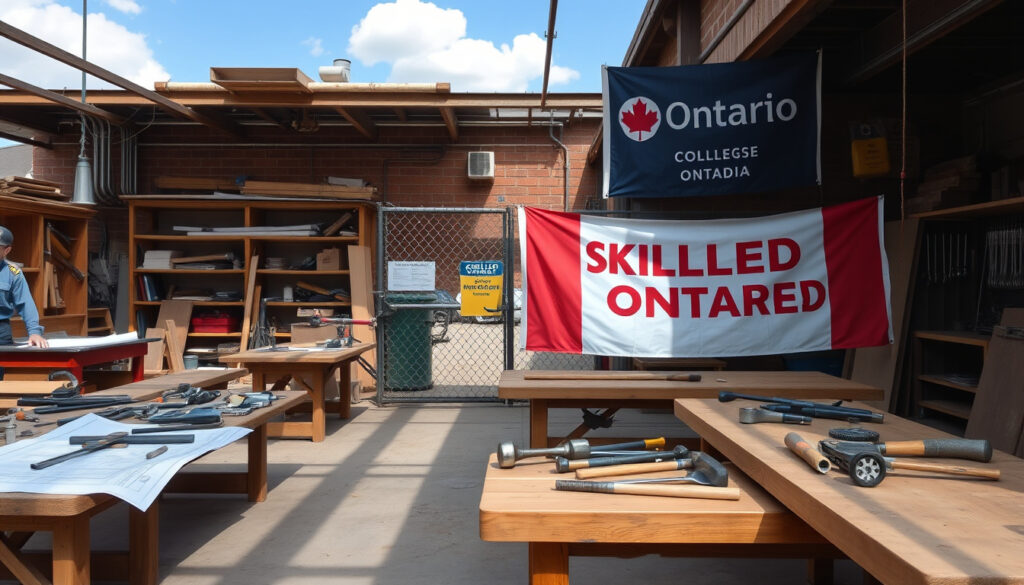
Ontario College of Trades: Closure to Skilled Trades Ontario
Ontario once had the country’s only self-governing body for construction trades, a body that stirred debate from the day it opened. Eight years later, the Ford government pulled the plug without warning, leaving apprentices and journeypersons scrambling for clarity. Here’s what that wind-down actually looked like, and what it means for anyone working in or entering the skilled trades.
Founded: April 8, 2013 · Replaced by: Skilled Trades Ontario · Regulated trades: Over 140 in Ontario · Official site: skilledtradesontario.ca · Prior role: Self-regulating body for skilled trades
Quick snapshot
- OCOT regulated skilled trades for 8 years until its wind-down announcement in October 2018 (IUOE Local 793)
- Skilled Trades Ontario legislation introduced May 6, 2021 (Mathews Dinsdale)
- OCOT was the first organization in Canada allowing construction trades to self-govern (IUOE Local 793)
- Exact calendar date of OCOT’s formal dissolution
- Full scope of certificate transition regulations still being finalized by the minister
- Precise number of affected members who needed to re-register with STO
- April 2, 2025 — STO takes full responsibility for apprenticeship registrations and certifying exams (Skilled Trades Ontario)
- In-school training still run by MLITSD after that date (Skilled Trades Ontario)
- New apprentices register through the Skilled Trades Ontario Portal with digital signatures
- Existing OCOT members must transition records; Prometric Canada administers certifying exams from 2025
- Over 140 trades remain available through apprenticeship programs province-wide
This table summarizes key facts about the now-closed regulatory body and its successor.
| Label | Value |
|---|---|
| Status | Closed; succeeded by Skilled Trades Ontario |
| Opened | April 8, 2013 |
| Website | skilledtradesontario.ca |
| Regulated | Skilled trades in Ontario |
| OCOT regulation duration | 8 years |
| Apprenticeship on-job share | 80% |
What happened to Ontario College of Trades?
The Ontario College of Trades opened its doors on April 8, 2013, following the Ontario College of Trades and Apprenticeship Act passed in 2009. It was a self-regulating body — a first in Canada — giving construction trades a direct hand in governing their own licensing and standards (Ontario.ca (Government of Ontario)).
“The Ontario College of Trades (OCOT) was the first organization in Canada that allowed construction trades to govern themselves.”
— IUOE Local 793, union representing construction trades
Announcement and reasons for closure
On October 26, 2018, the Ford government announced the sudden wind-down of OCOT without prior industry notice. The move created immediate uncertainty in Ontario’s construction sector, leaving trade workers and employers without a clear regulatory path forward (IUOE Local 793 (Union representing construction trades)). Critics within the union argued that the closure removed a unique accountability structure that had only existed for eight years.
Official closure date
While the wind-down announcement came in October 2018, the formal legislative replacement arrived on May 6, 2021, when legislation was introduced to rename OCOT as Skilled Trades Ontario (Mathews Dinsdale (Labour law firm)). The minister retained authority to regulate how existing OCOT certificates would be transitioned into the new body.
“Ontario colleges are very disappointed to be shut out of the Ontario government’s funding announcement for new skilled trades training centres.”
— Confederation College representative, 2023
Notices of contravention issued under OCOT’s remaining authority remain reviewable by the Ontario Labour Relations Board within 15 days of issuance — a holdover process that affects anyone with active disciplinary records from the old regime.
What is the new name for Ontario College of Trades?
Skilled Trades Ontario is the official successor to OCOT. It handles all apprenticeship registrations, program completions, and certifying exams as of April 2, 2025 (Skilled Trades Ontario (Provincial apprenticeship regulator)). The transition was part of a broader restructuring that moved regulatory authority back under direct government oversight.
Skilled Trades Ontario overview
Apprenticeship begins when a worker signs and registers a Training Agreement with Skilled Trades Ontario. The split between on-the-job training and in-class instruction follows an 80/20 model — 80% practical work experience, 20% classroom learning (Skilled Trades Ontario (Provincial apprenticeship regulator)). Over 140 trades are available through these programs province-wide.
Once registered, apprentices receive a wallet card that confirms their status on job sites — a document employers can verify against the Skilled Trades Ontario Public Register for compulsory trades (Skilled Trades Ontario (Provincial apprenticeship regulator)).
Key differences from OCOT
OCOT allowed trades to self-govern; STO centralizes registration and certification under government direction from 2025 (Mathews Dinsdale (Labour law firm)). Prometric Canada now administers certifying exams, replacing earlier arrangements. Apprentices manage agreements via the Skilled Trades Ontario Portal, which accepts digital signatures — a shift away from paper-based submissions (Skilled Trades Ontario (Provincial apprenticeship regulator)).
The implication: trades lost direct governance authority when OCOT folded, with the province now controlling certifications centrally.
Is Ontario College of Trades closing?
Yes. OCOT officially closed and was replaced by Skilled Trades Ontario. The timeline spanned from the October 2018 announcement through the 2021 legislation to the April 2, 2025 full operational handover (Ontario.ca (Government of Ontario)).
Timeline of closure
- 1998: Apprenticeship and Certification Act introduced skill sets (Ontario.ca (Government of Ontario))
- 2009: Ontario College of Trades and Apprenticeship Act passed; OCOT established (Ontario.ca (Government of Ontario))
- October 26, 2018: Ford government announces OCOT wind-down (IUOE Local 793 (Union representing construction trades))
- May 6, 2021: Legislation to rename OCOT as Skilled Trades Ontario introduced (Mathews Dinsdale (Labour law firm))
- March 22, 2023: $224 million announced for private training centres; colleges excluded (Confederation College (Post-secondary institution))
- April 2, 2025: Skilled Trades Ontario takes full apprenticeship responsibilities (Skilled Trades Ontario (Provincial apprenticeship regulator))
Member impacts
Anyone who held membership or certification under OCOT needed to have records transitioned to Skilled Trades Ontario. Apprentices who completed their programs after April 2, 2025, receive a Provisional Certificate of Qualification valid for one year if their trade requires a certifying exam (Skilled Trades Ontario (Provincial apprenticeship regulator)).
In-school training remains administered by the Ministry of Labour, Immigration, Training and Skills Development even after STO assumes full regulatory authority — meaning apprentices still deal with two bodies for different parts of their journey.
What trade is in high demand in Ontario?
Skilled trades demand varies across Ontario’s labour market, but construction, industrial, and service sectors consistently report shortages. The Ontario Youth Apprenticeship Program lets high school students earn co-op credits toward trade certification, creating an early entry pipeline (Ontario Colleges (Provincial college consortium)).
Most in-demand trades for 2026
Demand data from Skills Ontario points to construction electrician, refrigeration and HVAC technician, and plumber as consistently shortage areas. Residential construction growth has intensified pressure on these three trades in particular.
Skills Ontario insights
The organization promotes trades careers to youth and tracks pipeline health. Their research indicates that without stronger youth outreach, Ontario faces a compounding skilled trades gap as older workers retire — a pressure that the 2023 private-training funding model may not fully address.
Ontario colleges publicly criticized being excluded from the $224 million training centre announcement in 2023, calling it a misstep given their role in preparing students for trades careers. The province allocated $75 million over three years for operations at private centres instead.
Do you get paid to go to trade school in Ontario?
Apprentices earn wages during their on-the-job training from day one. The apprenticeship model is designed so that employers pay apprentices for the practical work portion — the 80% of training that happens on the job site (Skilled Trades Ontario (Provincial apprenticeship regulator)).
Apprenticeship pay structure
Wage rates vary by trade, level of apprenticeship, and employer. The in-class component is unpaid in most cases — apprentices attend technical training periods without employer compensation. Apprentice rates typically increase at each progression milestone.
Skilled Trades Ontario programs
Adults aged 18 and older apply online through the Skilled Trades Ontario Portal. Those under 18, or applicants unable to use the online system, submit by email or mail with a parent or guardian signature (Skilled Trades Ontario (Provincial apprenticeship regulator)). Contact options include 647-847-3000 or the toll-free line 1-855-299-0028.
Upsides
- Single regulatory body now handles registrations and exams province-wide
- Digital portal streamlines agreement management
- Over 140 trades remain accessible through apprenticeship pathways
- Red Seal certification enables inter-provincial mobility
Downsides
- Colleges excluded from 2023 training centre funding, limiting public training options
- In-school training still run separately by MLITSD, complicating the apprentice experience
- OCOT wind-down created sector uncertainty that took years to resolve
- Self-governance model eliminated — trades no longer directly govern licensing
The pattern: apprentices gain a unified registration system but lose the industry self-governance that OCOT provided.
What is a Red Seal?
The Red Seal endorsement is a nationally recognized credential attached to a Certificate of Qualification. When a trade has a Red Seal endorsement, holders can work in that trade across Canada without needing additional certification in each province (Skilled Trades Ontario (Provincial apprenticeship regulator)).
Red Seal requirements
To receive a Red Seal, apprentices must pass both their provincial certifying exam and meet any additional Red Seal requirements specific to their trade. Skilled Trades Ontario administers these exams; Prometric Canada delivers them as of April 2, 2025.
How do I start an apprenticeship with Skilled Trades Ontario?
Starting an apprenticeship with Skilled Trades Ontario involves finding an employer willing to sponsor, signing the Training Agreement, and submitting it through the portal. The process is entirely digital for those 18 and older with access to the online system (Skilled Trades Ontario (Provincial apprenticeship regulator)).
Step-by-step process
- Find an employer sponsor. Employers register as sponsors and sign the Training Agreement with the apprentice.
- Submit the Training Agreement. Apprentices 18+ submit via the Skilled Trades Ontario Portal. Those under 18 use email or mail with a parent or guardian signature.
- Receive wallet card. Registered apprentices get a wallet card proving their status on job sites — verifiable against the Public Register for compulsory trades.
- Progress through levels. Each level requires completed on-the-job hours and in-class training approved by MLITSD.
- Complete apprenticeship. Finish records, sign the Apprenticeship Completion Form, and apply for certification (Skilled Trades Ontario (Provincial apprenticeship regulator)).
Related reading: Best Travel Insurance Canada · What Is a Phishing Scam
skilledtradesontario.ca, skilledtradesontario.ca, skilledtradesontario.ca, canadiancontractor.ca, skilledtradesontario.ca
As Skilled Trades Ontario takes over registrations and certifications, prospective apprentices can bridge into the field through targeted pre-apprenticeship programs at Skilled Trades College of Canada.
Frequently asked questions
What is Skilled Trades Ontario?
Skilled Trades Ontario is the provincial body that regulates apprenticeship programs, administers certifying exams, and maintains certification records for skilled trades workers in Ontario. It replaced the Ontario College of Trades in 2021–2025.
How do I lookup my trade status?
The Skilled Trades Ontario Public Register allows employers and the public to verify the certification status of workers in compulsory trades. Apprentices and certified tradespeople can also log into the portal to check their own records.
What happens to my OCOT membership?
Existing OCOT memberships and certifications are being transitioned to Skilled Trades Ontario under regulations set by the minister. Workers should contact STO directly to confirm their records have been transferred and update any outdated information.
How to pay Skilled Trades Ontario fees?
Fee payments are processed through the Skilled Trades Ontario Portal. Apprentices and certified tradespeople manage renewals and registration fees online. Contact options for support are 647-847-3000 or 1-855-299-0028.
What are Red Seal requirements?
To earn a Red Seal endorsement, a worker must hold a Certificate of Qualification in a Red Seal trade, pass the provincial exam, and meet any trade-specific requirements set by Skilled Trades Ontario. The endorsement enables inter-provincial work mobility.
How to start a trade apprenticeship?
Find an employer willing to sponsor you, sign the Training Agreement, and register it through the Skilled Trades Ontario Portal if you are 18 or older. Those under 18 submit by email or mail with a parent or guardian signature.
What trades have reviews from Ontario workers?
Worker reviews and community feedback on specific trades are available through industry forums and trade association websites. Skills Ontario also publishes labour market reports that reflect worker experiences and demand trends province-wide.
Sources
- Skilled Trades Ontario
- Ontario.ca — Historical overview of apprenticeship legislation
- Ontario.ca — Skilled Trades
- Skilled Trades Ontario — Changes to apprenticeship and certifying exam services
- Skilled Trades Ontario — Starting your apprenticeship
- Skilled Trades Ontario — Finishing an apprenticeship
- Mathews Dinsdale — Province announces replacement for Ontario College of Trades
- IUOE Local 793 — Ford government announces the winding down of the Ontario College of Trades
- Confederation College — Colleges very disappointed be shut out of trades training announcement
- Ontario Colleges — School-to-work transition
- Skilled Trades Ontario — Portal
Meer gerelateerde berichten
 Meg Donnelly: Biography, Age, Relationships, and Movies
 Horoscope du Jour Taureau: Today’s Taurus Horoscope
 CPP and OAS Retirement Age Changes in Canada: 2026 Facts
 Anatomy of a Scandal: True Story, Cast, Plot & Season 2
 Michael Cooper Jr. – Biography, Age, Nationality, Netflix Role
 MSNBC Live Stream Free: Watch Online, No Cable Needed
 What Is a Mobile Hotspot? Definition, Uses & How It Works
 BC School Shooting Suspect: Jesse Van Rootselaar Details