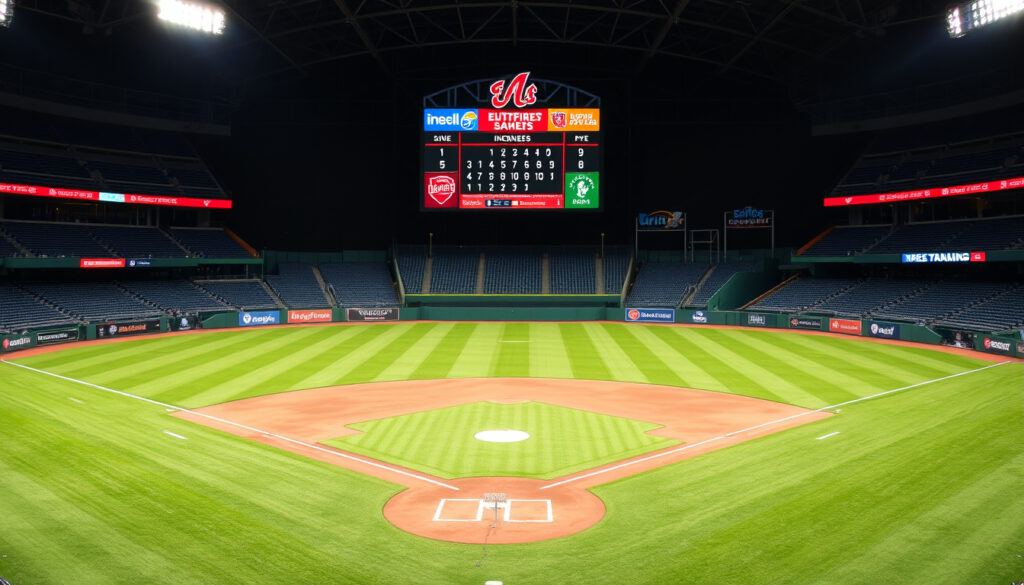
How Many Innings in Baseball? MLB Rules & Variations
Baseball’s nine-inning structure dates back to the 19th century, and it’s still going strong—a format that occasionally produces marathons far longer than any TV slot can accommodate. The longest MLB games on record have stretched past 20 innings, and that’s before considering the extra-inning rules that MLB made permanent in 2023.
MLB regulation game: 9 innings · Extra innings trigger: Tie after 9 · College baseball standard: 9 innings · Little League typical: 6 innings · No maximum innings: Until winner
Quick snapshot
- MLB regulation games are 9 innings (MLB.com Official Glossary)
- Extra innings begin when the score is tied after 9 complete innings (MLB.com Official Glossary)
- The exact historical reason why nine became the standard rather than seven or ten
- Whether minor league levels below Double-A have uniform extra-innings rules
- Minor League Baseball adopted the automatic runner rule in 2018, three years before MLB
- MLB made the rule permanent in 2023 after three seasons of testing
- Postseason games continue under traditional rules with no automatic runner
- International tournaments like the WBC follow MLB’s extra-innings approach
Five numbers matter most when understanding baseball’s inning structure:
| Rule | Value |
|---|---|
| Regulation innings (MLB) | 9 |
| Extra innings | Unlimited until winner |
| Called game minimum | 4.5 or 5 innings |
| College standard | 9 |
| Automatic runner starts | 10th inning |
Are there 7 or 9 innings in baseball?
Most professional and collegiate baseball games run nine innings, but the answer is more layered than a single number. MLB mandates nine innings per regulation game, a rule that appears in section 7.00 of the Official Baseball Rules. Youth and recreational leagues, however, frequently shorten games to six or seven innings to accommodate younger players, smaller fields, and shorter attention spans.
MLB professional standard
Since 1857, nine innings has been the universal standard for professional baseball in North America. The rule is straightforward: each team bats once per inning, and a game ends after the visiting team completes its turn at-bat in the ninth inning if the home team is ahead. MLB games can end earlier than nine innings only through a called game or forfeit.
Youth and recreational differences
Little League typically limits games to six innings, while many high school associations use seven. These adjustments reflect the physical demands on younger players and the goal of keeping games manageable—usually under two hours rather than the three-plus hours common in pro ball.
What happens if tied after 9 innings?
When a game is tied after nine complete innings, baseball extends into extra innings—and since 2023, MLB does so with a twist that has divided purists and casual fans alike. Starting in the 10th inning, the automatic runner rule places a runner on second base at the beginning of each extra inning, unless the game concludes before that extra half-inning begins.
Extra innings procedure
The runner placed on second base is typically the player who made the final out of the previous inning, or a pinch runner chosen by the manager. This runner starts in scoring position, dramatically increasing the odds of a decisive play within the first few batters of each extra inning. The rule was designed to shorten extra-inning games and reduce player fatigue—historically, these games could stretch to five or six hours.
One notable consequence: home teams now win extra-inning games at a 49.3% rate from 2020 through 2024, down from the traditional 52.2% under classic rules. This shift reflects the fact that the visiting team bats first in extra innings, giving them the chance to score before the home team gets its at-bat with a runner already in scoring position.
No time limit
Unlike soccer’s clock-stoppage variations or football’s overtime, baseball extra innings have no time cap. The game continues inning by inning until one team wins a completed extra inning. The longest game in MLB history under the traditional format was a 26-inning, 0-0 tie between the Brooklyn Robins and Boston Braves in 1920, called only because of darkness. The record for the longest completed game belongs to a 20-inning contest in 1906.
Postseason baseball plays by different rules. MLB postseason extra innings feature no automatic runner—the game continues with bases empty, just as it did before 2020. The pitch timer still applies during extra innings, giving pitchers 15 seconds with bases empty and 18 seconds with runners on base.
Why is baseball only 9 innings?
The nine-inning standard traces back to the mid-1800s, when baseball’s governing bodies sought a format that balanced player endurance, fan attention, and scheduling needs. Before 1857, games were played to a score threshold rather than an inning count. The nine-inning format proved durable enough to survive over a century of rule changes while remaining flexible enough to accommodate the longer games that occasionally emerge when teams remain tied.
Historical origins
The Knickerbocker Rules of 1845, devised by Alexander Cartwright, established the framework for modern baseball but didn’t mandate inning count. By 1857, clubs in New York agreed to nine innings, partly to standardize game length for betting and scheduling. The number stuck, likely because nine provided enough opportunity for comebacks and momentum shifts without exhausting players on open fields with no lights.
Rule standardization
Section 7.00 of the Official Baseball Rules now explicitly defines a regulation game as nine innings, with extra innings governed by Rule 7.02. This codification means nine isn’t arbitrary—it’s the sport’s fundamental unit, equivalent to quarters in football or sets in tennis.
The logic behind nine, rather than seven (as in some international formats) or ten, reflects practical trade-offs: nine allows for the visiting team to potentially overcome an early deficit, creates natural half-inning breaks for both teams, and fits within a broadcast window that keeps games accessible to casual viewers.
Some international baseball competitions use different formats. Japan’s NPB regular season caps extra innings at 12, after which games can end in a tie. The World Baseball Classic follows MLB’s unlimited extra-inning approach with the automatic runner rule.
How many innings can you go in a baseball game?
In theory, an unlimited number. Professional baseball has no upper limit on innings—the game continues as long as teams remain tied after each completed inning. In practice, the longest MLB games rarely exceed 18-20 innings, with the 16-inning Dodgers-Padres contest on August 25, 2021, standing as the longest game played under the automatic runner rule.
No upper limit
The rule is absolute: if tied after nine, play another inning. If still tied, play another. There’s no mercy cap, no sudden-death provision for regular-season MLB play, and no clock. Position players are even permitted to pitch during extra innings under MLB rules, which often accelerates game endings when bullpens thin out.
Record games
Historically, marathon games dominated minor league and exhibition play. The 1920 Brooklyn-Boston tie lasted 26 innings but ended without a winner due to darkness—a limitation modern domed stadiums have largely eliminated. The modern longest completed MLB game was 20 innings in 1906, a record unlikely to fall given pitch counts and player safety protocols that didn’t exist a century ago.
Minor League Baseball adopted the automatic runner rule in 2018, serving as a testing ground before MLB implemented it in 2020 as a COVID-19 measure. The Joint Competition Committee made it permanent in 2023 through a unanimous vote.
How many innings in baseball minor league?
Most minor league games follow the same nine-inning standard as MLB, but the details vary by level. Triple-A and Double-A typically mirror major league rules, while lower levels often shorten games and adjust extra-innings procedures to balance competition with player development.
MiLB variations
Minor League Baseball adopted the runner-on-second extra-innings rule starting in 2018, making it the earliest adopter among organized leagues. This gave MiLB three years of data before MLB adopted the same rule in 2020. The experiment suggested that automatic runners reduced game length without fundamentally altering competitive outcomes.
College and international
NCAA college baseball adopted the runner-on-second extra-innings rule in 2021, following MLB’s lead. Seven-inning doubleheaders are common in college play, reducing the load on weekend series where teams play multiple games. International competitions like the World Baseball Classic follow their own frameworks—the WBC applies MLB’s extra-innings rules including the automatic runner.
Upsides
- Automatic runner speeds up extra-inning games
- Position players can pitch in long extra-inning games, preserving bullpens
- Youth leagues benefit from shorter formats designed for developing players
Downsides
- Postseason exclusion creates inconsistency between regular and playoff play
- Home team win rate has dropped, which some argue disadvantages the home club
- Purists argue the rule cheapens walk-off moments
What experts and officials say
A regulation game consists of nine innings of play. If the score is tied after nine complete innings, play shall continue until the visiting team has scored one more run than the home team, provided the visiting team bats last.
— Official Baseball Rules, Rule 7.00
The runner placed on second base at the start of each extra inning shall be the player in the batting order who made the last out in the preceding inning, or a pinch runner if the manager chooses.
— MLB.com Extra Innings Rules
The automatic runner rule’s implementation reflects a broader tension in baseball between tradition and efficiency. The Joint Competition Committee’s unanimous 2023 vote to make the rule permanent signals that MLB views the experimental era complete—extra-inning games will continue to start with a runner on second base, and there’s no indication the sport plans to revisit that decision in the near future.
For viewers, the practical consequence is straightforward: expect games to run nine innings minimum, with tie games extending indefinitely under rules that favor quicker resolution. The sport’s longest games now rarely approach the marathon thresholds that defined pre-2020 extra-inning play, and the data from 2020 through 2024 suggests the rule has achieved its intended effect.
Related reading: Inter Miami vs PSG · Words With Friends Cheat
youtube.com, mlb.com, en.wikipedia.org, hollyland.com, espn.com, uspbl.com, milb.com, si.com, refrsports.com, youtube.com
While MLB games run nine innings under standard rules, middle school game durations often shorten to suit younger players and shorter attention spans.
Frequently asked questions
Is baseball 12 innings?
Baseball is not limited to 12 innings in MLB play—games continue indefinitely if tied. However, Japan’s NPB regular season caps extra innings at 12, after which games may end in a tie. MLB postseason play has no such cap.
How many innings in baseball Japan?
Japan’s NPB regular season caps extra innings at 12. If the game remains tied after the 12th inning, it ends in a tie. The Japan Series postseason, however, follows standard MLB rules with unlimited extra innings.
How many innings in baseball WBC?
The World Baseball Classic follows MLB’s extra-innings rules, including the automatic runner on second base beginning in the 10th inning. There’s no cap on extra innings in WBC play.
How many innings in baseball spring training?
Spring training games typically run five to seven innings, shorter than the nine-inning standard. The emphasis is on player preparation rather than game completion.
How many innings in baseball after 9?
After nine innings with a tied score, baseball enters extra innings starting with the 10th. In MLB regular season, a runner automatically begins on second base in the 10th inning and each subsequent extra inning. There’s no maximum inning count.
How many innings in baseball to win?
You win a baseball game by scoring more runs than your opponent after a completed inning. The game ends at the conclusion of an inning—never mid-inning, except through a called game due to weather or other interruptions.
What is the Ohtani rule?
The “Ohtani rule” is a nickname for the universal designated hitter rule that allows two-way players like Shohei Ohtani to bat without forfeiting their pitching duties. It doesn’t directly relate to extra innings or inning counts.
Meer gerelateerde berichten
 2026 Mazda CX-5: Pricing, Problems & RAV4 Comparison
 Blue Jays 2026 Schedule: Dates, Times, Printable PDF
 Book a Lab Appointment Online in Ireland (Step-by-Step)
 Wish You Were Here: Pink Floyd Song Story, Meaning & Funeral Fit
 Montreal Grand Prix 2025: Dates, Results, Tickets & Highlights
 Arthur and the Invisibles – Timeless Family Adventure
 Ontario College of Trades: Closure to Skilled Trades Ontario
 10 Minute Gout Cure: Fact or Fiction